DashRummy
Listing time : December 24, 2025
29 October 2025
36.9 MB
0.33
Android
4689
Description
DashRummy presents itself as a mobile-first rendition of traditional Indian rummy — a social, strategic, and highly replayable card game. For players who grew up with family rummy nights or newcomers attracted by fast-paced matching and meld-building, DashRummy promises an accessible digital alternative: quick matches, online opponents, tutorial aids, and social features that turn a solitary device into a lively card table.

What is Indian Rummy
Indian rummy is commonly played as a 13-card meld game where the objective is to form valid sets and sequences (also called runs). A sequence is three or more consecutive cards of the same suit; a set is three or four cards of the same rank but different suits. The game uses two standard 52-card decks plus jokers (in many variants). Play proceeds in a draw-and-discard style: on each turn a player draws one card (from the closed deck or the open pile) and discards one card to the open pile.
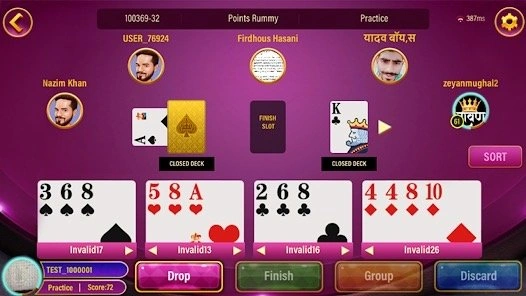
DashRummy adapts this core mechanic to mobile: players draw cards, form sequences and sets on a digital table, and discard to an open pile. The app typically includes:
-
A clear visual card layout and drag-and-drop or tap-to-meld interactions.
-
Tutorial or practice modes for beginners.
-
Matchmaking for casual or ranked play.
-
Social play options (friends, private tables, chat).
-
Customer support or in-app help.
Core Gameplay: Rules and Turn Flow
Below is a concise, practical explanation of the gameplay and common rules seen in Indian rummy-style apps like DashRummy.
-
Initial deal: Each player receives 13 cards. One card is placed face-up to start the open pile; the rest form the closed stock.
-
Turn sequence:
-
Draw: On your turn, draw one card — either the top card of the closed stock or the top card of the open pile.
-
Meld (optional): Players may place valid sequences and sets on the table when they are ready to declare.
-
Discard: At the end of the turn you must discard one card to the open pile.
-
-
Valid declaration: To declare, a player must have at least two sequences, one of which must be a pure (closed) sequence — that is, a sequence without a joker. All remaining cards must form valid sequences or sets (jokers can substitute).
-
Joker rules: Jokers include printed wild cards and wildcards selected from the deck (a card chosen during deal). Jokers substitute for missing cards in sets or sequences but cannot count as a pure sequence card.
-
Scoring: When a player declares, opponents’ remaining unmatched cards incur penalty points usually equal to the card value (face cards 10 points, numbered cards their pip value, jokers zero). The lower the points, the better.
-
Game variants: DashRummy may support multiple variants (e.g., 101 points, 201 points, deals per match). Pay attention to variant selection before starting a table.
Beginner’s Guide: How to Start and Win Your First Game
If you’re new to rummy, start with the basics and a slow learning curve.
-
Learn the objective: Build valid sequences and sets; ensure one pure sequence.
-
Follow opening principles:
-
Prioritize building a pure sequence early.
-
Avoid collecting too many unrelated cards.
-
-
Discard smart: Discard high-point cards that are unlikely to help your melds — especially face cards — when safe to do so.
-
Watch the open pile: If opponents pick from the open pile often, they may be collecting particular numbers or suits; use that to infer their needs.
-
Use jokers carefully: While jokers reduce penalty risk, avoid relying solely on jokers to form both sequences needed for declaration.
-
Practice with tutorial mode: DashRummy’s tutorial or practice tables are ideal for learning timing and flow without competitive pressure.
Advanced Strategies That Make a Difference
Once you understand the rules, adopt strategies that increase consistency and reduce risky plays.
1. Pure sequence priority
Always aim to complete a pure (no-joker) sequence early. Without it, you cannot declare — so your hand’s primary focus should be a genuine consecutive run.
2. Two-front construction
Work on at least two potential melds simultaneously. If you wait for one perfect combination, you’ll be vulnerable to being undercut by opponents.
3. Defensive discards
Be cautious throwing away cards that your opponent might use. Observe their picks: if someone draws a 7 of hearts from open pile and then discards a 9 heart, you can deduce they’re likely working on heart sequences centered around 7–9; avoid discarding adjacent hearts.
4. Joker economy
Treat jokers as emergency insurance. Use them to complete low-cost sets that free up your high-value cards for safer discards.
5. Card counting and probability
Track the cards shown in the open pile and what opponents pick. Infer the probability of drawing useful cards from the closed deck and adjust risk-taking accordingly.
6. Timing the declare
Don’t declare immediately when you have a complete hand if you suspect opponents may have lower points or a better chance to undercut — but don’t hang on too long and let someone else finish.
Common Mistakes to Avoid
-
Chasing all jokers: Collecting many jokers without forming pure sequences wastes turns.
-
Ignoring pure-sequence requirement: Players who forget the pure sequence rule often lose despite near-complete hands.
-
Random high-card discards: Discarding high-point cards recklessly can balloon your penalty when someone declares.
-
Predictable play: Always discard the same suit or same rank; vary your style to confuse observant opponents.
Social Features
A strong rummy app is not only about gameplay but also community. Good social design can boost retention and monetization:
-
Friend tables and private matches: Let players invite friends for private games; personalization and competition keep players returning.
-
In-game chat and emojis: Real-time chat, quick reactions, and expressive emojis make matches more social.
-
Leaderboards and seasonal events: Monthly leaderboards, tournaments, and limited-time events encourage continued play and healthy competition.
-
Clubs/Guilds: Allow groups to form with shared rewards and club-specific tournaments.
-
Spectator mode and tutorials: Watching top players can help newcomers learn faster and feel part of the community.
Retention and Engagement Tactics
To keep players for the long term, combine incentives, fresh content, and social glue:
-
Daily rewards and streaks: Encourage login frequency with escalating daily rewards.
-
Progression and achievements: Unlock new avatars, card backs, and table themes as players progress.
-
Event calendar: Weekly and monthly tournaments, holiday-themed events, and limited-time challenges.
-
Push notifications (carefully): Remind players about ongoing tournaments or friend invitations without spamming.
-
Onboarding funnels: Segment new users for progressive skill-based matchmaking to avoid early frustration.
FAQ
Q: How many players can play in a single DashRummy table?
A: Indian rummy variants support 2–6 players depending on rules; many mobile tables commonly host 2–6 players. Check the table settings before joining.
Q: Do I need an internet connection?
A: Because DashRummy is an online multiplayer game, an internet connection is typically required for real-time play. Offline practice against bots may be available depending on the app.
Q: Are jokers allowed?
A: Yes. Jokers play a central role: printed jokers and a wildcard selected during the deal can substitute for missing cards, but a pure sequence must remain joker-free.
Q: Is DashRummy safe to use?
A: Safety depends on app policies and technical practices. Look for secure payment methods, clear privacy policy, anti-fraud measures, and responsive customer support.
What's new
Minor bug fixes and improvements.
Images