Rummy Cafe
Listing time : December 29, 2025
25 February 2024
25 MB
1.0.6
Android
2545
Description
Rummy Cafe is more than a mobile app; it’s a compact arena where strategy, memory, patience, and a dash of risk-taking meet. As a veteran Rummy player, I’ve spent countless hours dissecting hands, refining strategies, and learning what separates casual wins from consistent success. This article dives deep into the Rummy Cafe experience: rules, variations, strategy (from beginner to advanced), bankroll and tournament management, UI and social features that matter, common pitfalls, and practical tips to improve your game. Whether you’re stepping into Rummy Cafe for the first time or you’ve already logged hundreds of hands, this guide will give you the context and tools to play smarter and enjoy the game more.
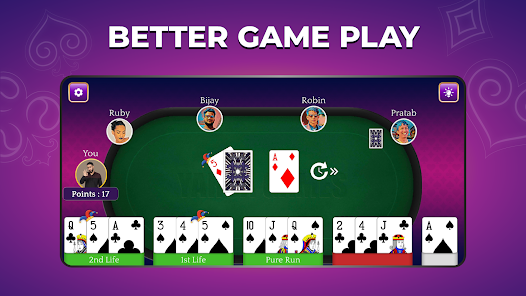
1. What is Rummy Cafe?
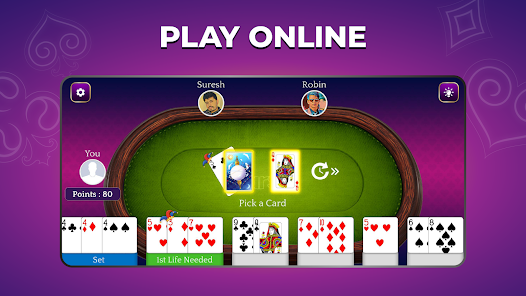
Rummy Cafe is an online adaptation of classic rummy designed for mobile play. Its core gameplay revolves around forming valid combinations from the cards dealt — sequences (consecutive cards of the same suit) and sets (same rank cards of different suits). A typical round challenges players to arrange their hand into the required number of sequences and sets under rules that often include the necessity of a pure sequence (one without jokers).
Rummy Cafe tends to emphasize pace and competitiveness. The app is built to be intuitive for newcomers while offering layers of depth for experienced players through tournament modes, varied table types (pool or points), and features that support both casual and ranked play. The convenience of playing anytime, paired with the game’s strategic richness, is what keeps players coming back.
2. Core Rules
Although different tables and modes may tweak details, the fundamental rules that govern most Rummy Cafe games are:
-
Objective
Arrange all the cards in your hand into valid groups before your opponents do. A valid group is either:-
Pure Sequence: three or more consecutive cards of the same suit without jokers.
-
Impure Sequence: like a pure sequence but can include jokers.
-
Set: three or four cards of the same rank in different suits (jokers typically not allowed in pure sets unless rules state otherwise).
-
-
Number of Sequences
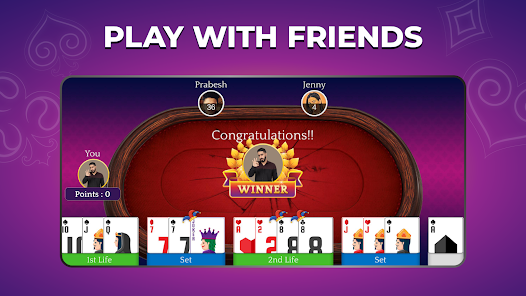
Most standard games require at least two sequences, and at least one of them must be a pure sequence. This is often referred to as the “1st life” (pure) and “2nd life” (pure or impure). -
Jokers
-
Printed Jokers are special cards in the deck.
-
Wild Jokers (substitutes) can be designated by drawing a random card which becomes a joker for that round.
-
Jokers can complete impure sequences and sets but cannot be used in place of the mandatory pure sequence.
-
-
Dealing and Turns
Each player is dealt a fixed number of cards (commonly 13) depending on the variant. Players draw a card (from the open discard or closed deck) and discard one card in each turn. -
Declaring and Showing
When you have arranged your hand into valid groups fulfilling the sequence requirement, you declare. Many apps have a “show” procedure where your hand is verified, and points are tallied based on ungrouped cards. -
Scoring and Penalties
Unfinished cards count as penalty points — high cards (10, J, Q, K, A) usually count 10 points each, numbered cards count at face value. Some modes use pool scoring where players accumulate points across multiple rounds. -
Variations
Rummy Cafe may offer different variants: 2-player vs 6-player, pool vs points, speed rummy, and tourneys with special rules (e.g., 21-card rummy or 106/201 points variants). Always check table rules before joining.
3. Common Game Modes and Table Types
Understanding the mode and table type affects strategy:
-
Points Mode: Every round ends when someone declares. Points are awarded and accumulated; the goal is to have the lowest total points after a set number of rounds.
-
Pool Mode: Players compete until one player’s score reaches a preset pool limit. This mode rewards consistency over single-round brilliance.
-
Tournaments: Multi-table events where players qualify through rounds. These require tournament-specific strategies, like conservative play early on and increased aggression in later rounds.
-
Speed/Blitz: Faster deal times and fewer cards sometimes, favoring players who can adapt quickly.
-
Practice Tables: Lower stakes, great for testing strategies or learning the app mechanics.
4. Practical In-Game Tips
Small habits add up:
-
Use the Auto-Complete Sparingly: Many apps provide suggestions. Use them as learning aids, not crutches.
-
Quick Declares vs Careful Shows: A quick declare might be valid but if your app penalizes incorrect shows harshly, double-check before showing.
-
Practice Simulations: Play practice games focused on a single objective — e.g., prioritize pure sequences only — to strengthen particular skills.
-
Keep a Discard List: Mentally track discarded cards; it informs which combinations are still possible.
-
Adapt to Table Speed: Fast tables demand quicker decisions—train to make good choices under time constraints.
5. Managing Bankroll and Risk
-
Set a Session Budget
Decide how much you’re willing to lose in a session. Once you hit that limit, walk away. -
Buy-in Strategy
For tournaments, choose buy-ins that match your bankroll. A common rule: do not risk more than 1–2% of your bankroll on a single tournament entry if you’re playing regularly. -
Adjust Playing Style by Stakes
At low stakes, players often make more mistakes; play a bit looser to exploit errors. At high stakes, tighten up and focus on minimizing mistakes. -
Record Keeping
Track wins, losses, and your play patterns. Reviewing your own history helps you identify leaks — repeated mistakes that cost you points or money.
6. FAQs
Q: Can you win without jokers?
A: Absolutely. Jokers help speed up impure sets but skillful construction of pure sequences and sets makes wins without jokers common.
Q: Is it better to pick from discard or deck?
A: If the discard gives you a guaranteed or high-probability improvement toward your pure sequence or set, pick it. If not, draw from the deck to maintain secrecy and flexibility.
Q: When to bluff in rummy?
A: Bluffing is subtle in rummy—mostly by discarding misleading cards or feigning interest in a suit. Full-scale bluffing is risky because rummy has visible information that counters pure bluffs.
Conclusion
Rummy Cafe captures the timeless appeal of rummy: elegant rules that unfold into deep strategy. As with any skill game, improvement comes from deliberate practice, studying hands, and learning from mistakes. Start by securing a pure sequence reliably, expand into flexible two-way plays, and then refine your opponent profiling and tournament strategies. Balance aggression with prudence, manage your bankroll, and respect fair play. With patience and disciplined learning, you’ll find that victories become more frequent and more satisfying.
Images